
Australian Government System
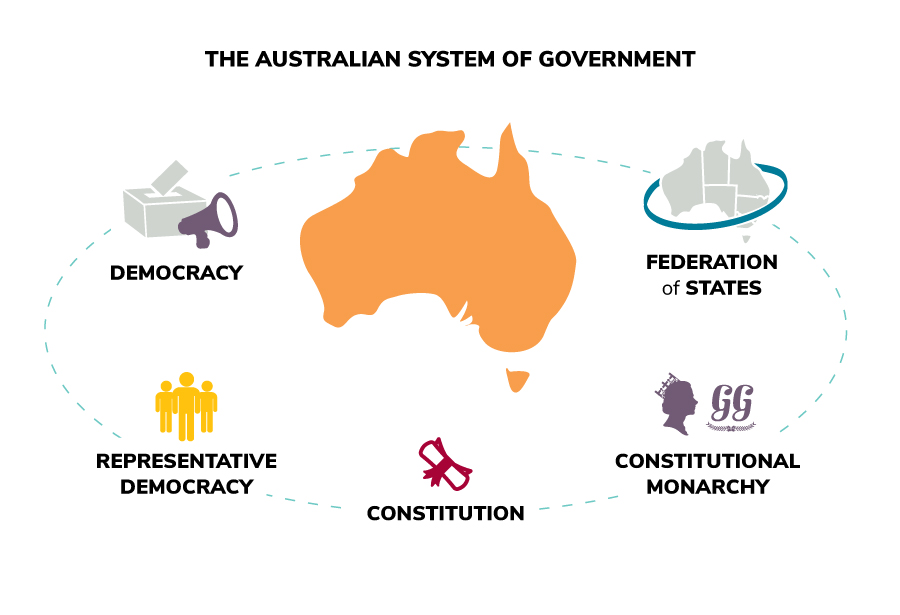
Australia has a mixed system of government; it is a representative democracy and a constitutional monarchy. It is also a federation of states.
Representative democracy
In a representative democracy, citizens choose candidates to represent them in a parliament. In Australia, federal elections are held approximately every three years to elect members of parliament to represent Australians and make laws on their behalf.
Examples of other representative democracies include the United States, United Kingdom, and Argentina.
Constitutional monarchy
In a constitutional monarchy, the monarch does not have absolute power — they are subject to the country’s constitution. Australia’s head of state is King Charles III. The King appoints the Governor General to act on his behalf.
Examples of other constitutional monarchies include Belgium, Tonga, and Sweden.
Federation of states
A federation is a group of states that have joined together to form a single country. In 1901, six British colonies merged to form the nation of Australia. Before that and for at least 50 000 years, Aboriginal and Torres Strait Islander peoples lived on the Australian mainland and practiced traditional cultures and languages. The colonies became Australian states and a Federal Parliament was established with the power to make laws on national issues such as defence, immigration, trade and foreign affairs. The Australian Constitution — the set of rules by which Australia is governed — sets out how the federal and state parliaments share law-making power.
The Federal Parliament alone does not make all laws across the country. The three levels of government work together to provide Australians with the services they need. The three levels are:
- Federation — Australia — Parliament, in Canberra.
- State and territory parliaments, in each state and territory capital city.
- Local councils — also known as shires — across Australia.
Some examples of other federations include Canada, India, and Germany.
Decentralization
The Australian Constitution identifies three groups — Parliament, Executive and Judiciary — and describes how they share power. Separation of powers helps ensure that no one group has all the power, by giving each group their own area of responsibility:
- Parliament (Legislature) makes and changes laws.
- The executive puts the law into practice.
- Judiciary resolves legal disputes.
Related articles


Treasurer Jim Chalmers officially announced the 2026 Australian Federal Budget, focusing on reforming the tax system and enhancing national security in the context of inflation and global geopolitical turmoil. Housing Policy Reform The government focuses on addressing the housing and tax system to support the younger generation (Millennials and Gen Z) through systemic changes. From […]

The Federal Government has officially announced its 2026-2027 budget, with reforms to Australia’s real estate, tax system and increased housing supply aimed at helping more Australians own their homes. Support home ownership and increase supply Australian property tax reform: Change regulations on negative gearing and capital gains tax (CGT) incentives. The changes are estimated to […]

The birth of the Metro West line is not simply a transportation solution; it is symbolic of Sydney’s transformation into a connected megacity. With a record investment of up to 27.3 billion Australian dollars, the project promises to unlock the potential for tens of thousands of luxury apartments, turning areas along the route into the […]