

Australians Are The Richest People In The World!
Nearly 2.2 million Australians became millionaires after a surge in asset prices pushed another 390,000 adults to the top rungs of the global wealth ladder, according to a Credit Suisse report, which said Australians are the world’s richest people.
The figure could mark a near-term peak for Australia, as falling property prices are poised to drag on Australians’ paper wealth this year.
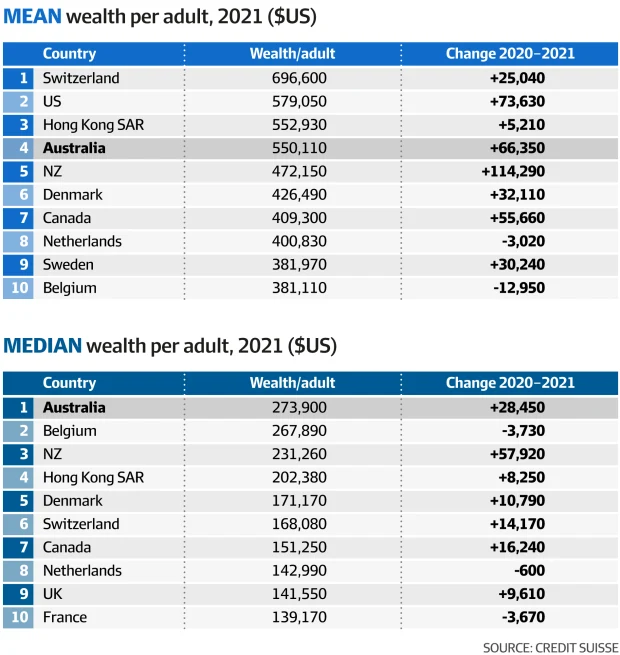
The average Australian adult ended 2021 with a net worth of $273,900, making them wealthier than comparable residents of any other country, according to Credit Suisse’s annual global wealth report.
This means that 50% of Australians are worth less than this amount and 50% of Australians are worth more. The next richest jurisdictions are Belgium, New Zealand and Hong Kong.
Soaring share and property prices pushed average wealth per Australian adult to $28,450 in 2021. The only country whose citizens’ wealth increased more than that was New Zealand, where average wealth increased by $57,920.
According to data from CoreLogic, detached real estate prices increased an extraordinary 24.6% in 2021 and unit values increased by 14.2%. The ASX 200 delivered a total return of 17.2% last year.
On an average wealth basis, Australia is the fourth richest country in 2021 after Switzerland, the US and Hong Kong. The average Australian adult was worth $550,110 at the end of last year, after enjoying an annual increase in wealth of $66,350.
Favorable market conditions have pushed another 390,000 Australians into the group of 62.5 million – US dollar millionaires globally.
But the boom in asset prices has pushed wealth inequality higher. The richest 1% of Australians held 21.8% of the country’s wealth in 2021, up from 19.6% in 2007.
Millionaire’s paradise
Australia had 2.18 million US dollar millionaires in 2021, accounting for 3.5% of the global total.
Only seven countries – the US, China, Japan, UK, France, Germany and Canada – have more millionaires than Australia.
Credit Suisse expects the number of domestic US dollar millionaires to rise to 2.94 million by 2026, an increase of 35%.
Credit Suisse said: “With limited GDP growth and the likelihood of asset prices falling from their peak values at the end of 2021, we expect the number of millionaires in the US to grow 13% over the next five years compared to a 97% increase (to 12.2 million) for China.
“We expect little or no change in the millionaire rankings of the countries with the next highest number of millionaires: Japan, the United Kingdom, France, Germany, Canada and Australia.”
Australia is now home to 4630 ultra-high net worth individuals after another 1350 adults crossed the $100 million threshold last year.
Globally, there were 84,490 ultra-high net worth individuals at the end of 2021, more than half of whom lived in North America.
Real estate lovers
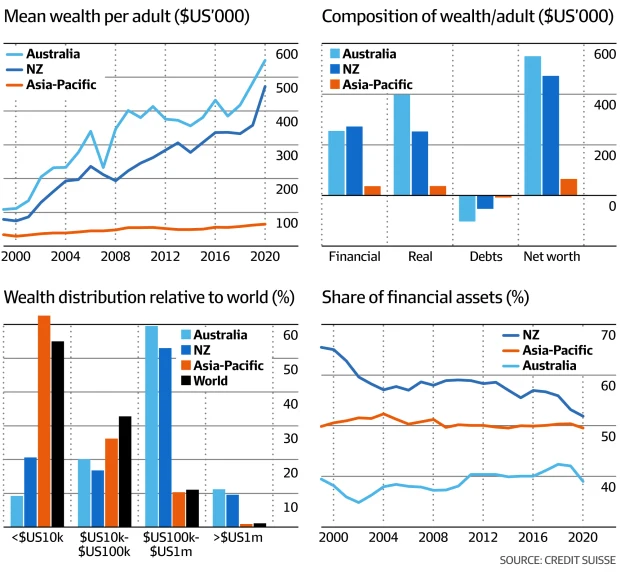
The report says that “the overall composition of assets or wealth has not changed much in Australia since 2000” and that Australians show a relatively strong preference for residential assets compared to their global peers.
In fact, more than 95% of the country’s housing is owned by single households, according to research by the Reserve Bank of Australia, compared with about 80% in the US and 70% in Germany.
Financial assets such as shares accounted for about 39.5% of Australians’ total wealth in 2021, below the typical high-income country level of 55%.
Falling real estate prices and a turbulent stock market are likely to contribute to slower growth or an outright decline in wealth this year.
The favorable conditions that underpinned last year’s astonishing rise in assets are unlikely to persist, said Michael Marr, head of wealth management at Credit Suisse.
“Going forward, we remain wary of the impact of rising inflation, an inevitable rise in interest rates with a direct impact on the valuation of two key asset sources, housing and financial assets, underpinned by GDP.”
Barrenjoey chief economist Jo Masters said on Monday she expected higher interest rates to cause property prices nationally to fall by 16 per cent and in Sydney by 25 per cent.
House prices in the capital city have fallen 4.4 per cent in the past three months, led by a 6.3 per cent fall in Sydney, according to CoreLogic’s daily house value index. Values in Brisbane were 4% lower compared to the previous quarter and prices in Melbourne were down 3.9%.
Related articles


Treasurer Jim Chalmers officially announced the 2026 Australian Federal Budget, focusing on reforming the tax system and enhancing national security in the context of inflation and global geopolitical turmoil. Housing Policy Reform The government focuses on addressing the housing and tax system to support the younger generation (Millennials and Gen Z) through systemic changes. From […]

The Federal Government has officially announced its 2026-2027 budget, with reforms to Australia’s real estate, tax system and increased housing supply aimed at helping more Australians own their homes. Support home ownership and increase supply Australian property tax reform: Change regulations on negative gearing and capital gains tax (CGT) incentives. The changes are estimated to […]

The birth of the Metro West line is not simply a transportation solution; it is symbolic of Sydney’s transformation into a connected megacity. With a record investment of up to 27.3 billion Australian dollars, the project promises to unlock the potential for tens of thousands of luxury apartments, turning areas along the route into the […]