
RENT PRICES IN AUSTRALIA ARE Climbing: WHERE ARE THE HIGHEST INCREASES?
Expensive housing prices in Australia have forced people to rent smaller houses, and rents in the city have increased by nearly 20%.
Rent prices in Australia continue to rise, people cannot afford to buy a house, causing the cost of renting small houses to increase dramatically.
According to the latest market report from real estate research firm PropTrack, apartment rents nationwide increased 13.5% year-on-year in the third quarter, outpacing housing’s increase of 9.1%.
The report also shows that rental growth as a share of total housing increased 3.4% quarter-over-quarter – one of the highest increases in confirmed history following increases in the first quarter of 2023.
According to PropTrack, the average rental price for housing is $600 a week.
How much have apartment rental prices increased?
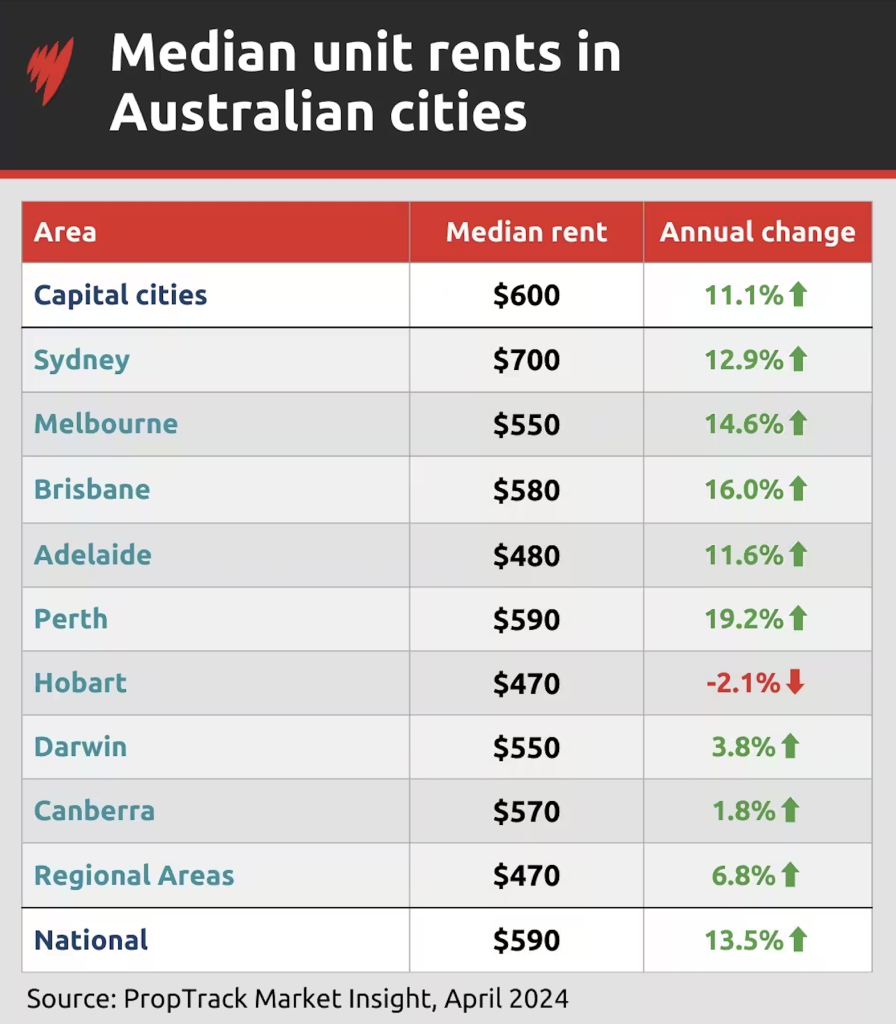
Nationally, the average apartment rental price in the March quarter was $590 a week, also according to PropTrack.
Perth is the area confirmed to have the largest annual price increase, Sydney is the city with the most expensive rent in Australia.
After an increase of 19.2%, apartments in Perth now have an average rental price of around $590 a week, while Sydney has increased by 12.9%, currently renting for up to $700 a week.
In Brisbane, prices rose 16% to an average of $580 a week, while in Melbourne prices rose 14.6% to $550 a week.
The average rent for an apartment in Adelaide increased by 11.6% to around $480 a week.
In Darwin, the average increased by 1.8% and in the ACT by 1.8%, bringing average rental costs in these areas to $550 and $570 per week respectively.
Only in Hobart did the average weekly apartment rent decrease – 2.1% to $470 a week.
How much have rent prices increased?
Nationally, rental costs increased at a steady annual rate, about 9.1% year-over-year to about $600 a week.
Sydney remains the most expensive city with weekly rent recorded increasing by 10.3% to $750.
Next in line is the ACT, with an average rental cost of $700 after a 1.45% increase; Darwin with $680 a week (up 4.62%); Brisbane with $640 a week (up 10.34%); Adelaide is $590 (up 12.38%); and Melbourne at $575 a week (up 15%).
Hobart is the central city with the lowest rents, with average prices at $560 a week.
The highest price increases continued to be recorded in Perth, with the average weekly price increasing 16% to $650.
PropTrack senior economist Paul Ryan said the rise in apartment rents could be due to a few factors.
“The first factor may be because all apartment locations are operating again as the service industry, offices, universities,… open after the epidemic.”
“The second factor is putting pressure on apartment rents at the moment from the cost of renting a house… due to rent increases over the past few years. So people are looking for alternatives, choosing even smaller apartments.”
Will the rise in rent prices in Australia slow down?
Some signs show that the market is slowing down.
According to Ryan, advertising rents increased 9.1% over the past year, which is the lowest annual increase recorded since December 2021.
“The rental market is still a challenge for tenants, especially the supply does not meet demand, the current vacancy rate is still low at nearly 1%.”
“However, rental growth is slowing, which is a positive sign and hopefully we will see that trend continue between now and the end of 2024.”
A study by economic forecaster Oxford Economics Australia, published this week, shows rental growth is expected to decline over the three years to 2027.
This slowdown may be due to the reduced affordability of tenants, combined with interest rate cuts from banks.
“Household affordability has peaked which will limit rent increases, while bank interest rate cuts expected by the end of 2024 are expected to ease property-related costs,” said Maree Kilroy, senior economist at Oxford Economics and author of the report.
Kilroy also expected the vacancy rate to increase “a bit”, and said the wave of migration from abroad “seems to have peaked”.
Source: SBS News
Disclaimer:
“The content of the article is based on reliable sources of information. However, the information here is for general reference only and should not be considered official or complete. The use of the content and information on this website is the sole responsibility of the reader. We are not responsible for any consequences, damages or losses caused to the reader or any third party related to the use of information on this article or website whether directly or indirectly.”
Related articles


Treasurer Jim Chalmers officially announced the 2026 Australian Federal Budget, focusing on reforming the tax system and enhancing national security in the context of inflation and global geopolitical turmoil. Housing Policy Reform The government focuses on addressing the housing and tax system to support the younger generation (Millennials and Gen Z) through systemic changes. From […]

The Federal Government has officially announced its 2026-2027 budget, with reforms to Australia’s real estate, tax system and increased housing supply aimed at helping more Australians own their homes. Support home ownership and increase supply Australian property tax reform: Change regulations on negative gearing and capital gains tax (CGT) incentives. The changes are estimated to […]

The birth of the Metro West line is not simply a transportation solution; it is symbolic of Sydney’s transformation into a connected megacity. With a record investment of up to 27.3 billion Australian dollars, the project promises to unlock the potential for tens of thousands of luxury apartments, turning areas along the route into the […]