
TAX CUT FOR ALL PEOPLE IN AUSTRALIA
Pressured by expensive living costs, the Australian Government has decided to introduce tax cuts in Australia for 13.6 million taxpayers from July 1, 2024.
1. Overview of Australian tax cuts in Australia
The Australian Government has introduced changes to personal income tax rates and thresholds.
From July 1, 2024:
- Tax rate 19% reduced to 16%
- Tax rate 32.5% reduced to 30%
- 37% tax threshold, increased from AUD 120,000 to AUD 135,000
- The starting tax threshold is 45%, increased from AUD 180,000 to AUD 190,000.
These changes apply to Australian taxpayers.
2. Details of the tax cut plan in Australia
2.1 What is tax reduction?
Tax reduction, also known as tax incentives, is a change in tax rates and taxable income thresholds. This is a method to reduce the taxpayer’s tax liability.
This concept is the opposite of a tax refund. Tax refund is the amount of money received back from the Australian Taxation Office (ATO), if the taxpayer overpays when completing the tax payment obligation.
2.2 When will tax reduction be available?
New tax rates and taxable income thresholds apply from July 1, 2024.
For most taxpayers, any income from salaries and wages of employees working at the enterprise will be exempted or reduced from monthly tax on the day the salary is received.
Others will receive tax reductions after the end of the tax declaration period in 2024-2025.
However, this decision is applied this year so it does not affect the tax payment obligation made in 2023-2024.
2.3 How to receive tax cuts?
If you are an employee, the employer, after updating the employee’s withholding tax amount (PAYG), then pays the remaining salary periodically every month.
Check your pay stub or ask your employer if you received the new tax break.
Employers need to use the new tax rates and tax tables from 1 July 2024.
3. New personal tax thresholds and rates for 2024-2025
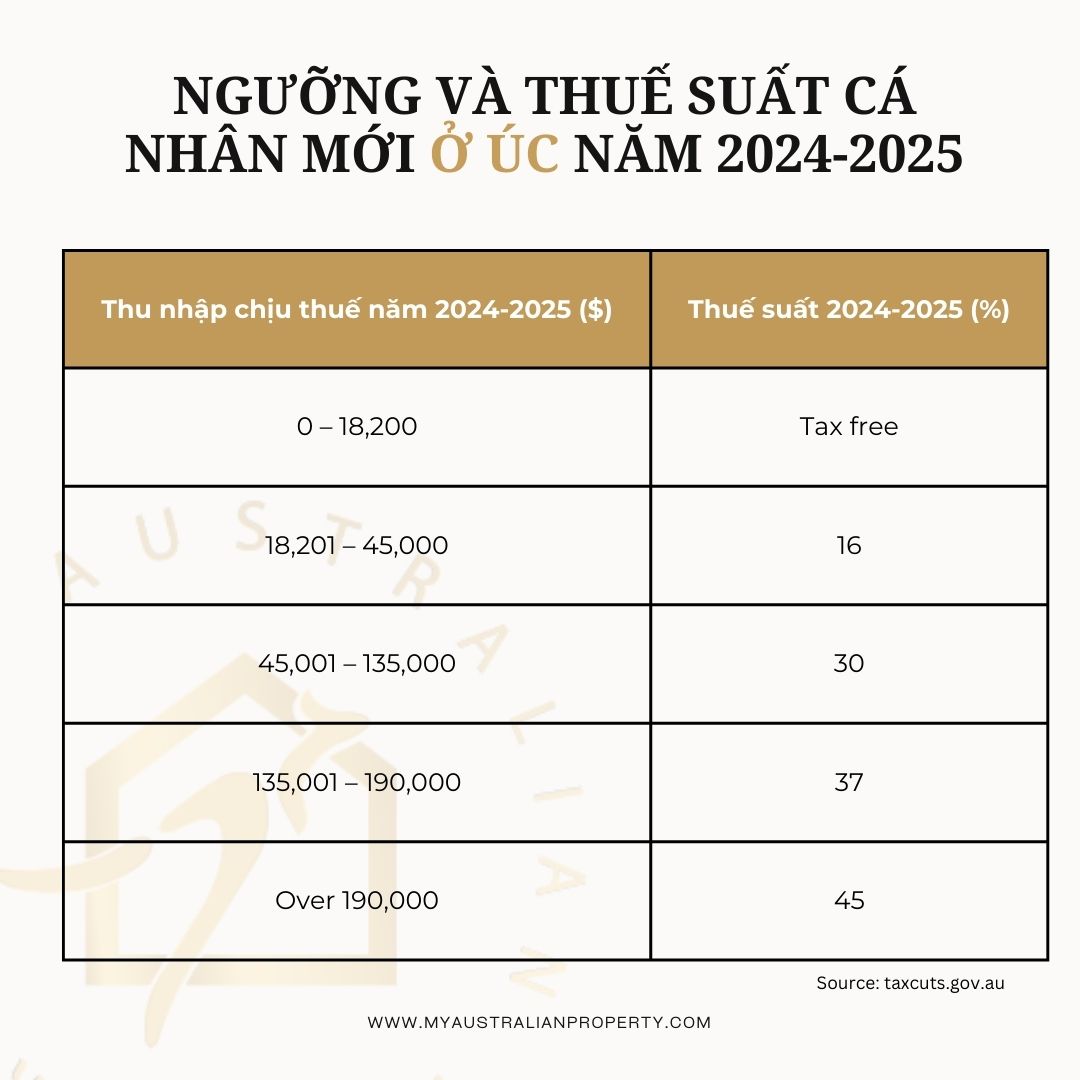
This table compares the personal income tax rates and thresholds for 2023-2024 with the new tax rates and thresholds for 2024-2025.
| Taxable income in 2023-2024 ($) | Tax rate 2023-2024 (%) | Taxable income 2024-2025 ($) | Tax rate 2024-2025 (%) |
| 0 – 18,200 | Tax free | 0 – 18,200 | Tax free |
| 18,201 – 45,000 | 19 | 18,201 – 45,000 | 16 |
| 45,001 – 120,000 | 32.5 | 45,001 – 135,000 | 30 |
| 120,001 – 180,000 | 37 | 135,001 – 190,000 | 37 |
| Over 180,000 | 45 | Over 190,000 | 45 |
4. How do tax rates in Australia work?
If you are an Australian taxpayer, you are exempt from tax if your taxable income is below $18,200. This means you can get 100% tax exemption if your yearly income is less than A$18,200.
If income is between $18,201 and $45,000:
- The first $18,200 is tax-free
- And, you’ll pay 16% on the remaining $18,201 to $45,000.
If income is between $45,001 and $135,000:
- The first $18,200 is tax-free
- 16% is calculated for the portion from $18,201 to $45,000
- Add 30% to remaining income calculated from $45,001 to $135,000.
If income is between $135,001 and $190,000:
- The first $18,200 is tax-free
- 16% is calculated for the portion from $18,201 to $45,000
- Add 30% to income calculated from $45,001 to $135,000
- And, 37% for income calculated from $135,001 to $190,000.
If income is over $190,000:
- The first $18,200 is tax-free
- 16% is calculated for the portion from $18,201 to $45,000
- Add 30% to income calculated from $45,001 to $135,000
- 37% for income calculated from $135,001 to $190,000
- Finally, 45% for the portion above the $190,000 threshold.
Low-income taxpayers and the elderly may qualify for direct tax breaks.
For more information please contact the My Australian Property team now!
Disclaimer:
Article content is based on reliable information sources. However, the information herein is for general reference only and should not be considered official or complete. Use of the content and information on this website is the sole responsibility of the reader. We are not responsible for any consequences, damages or losses caused to readers or any third parties related to the use of information on this article or website, whether directly or indirectly.
Related articles


Treasurer Jim Chalmers officially announced the 2026 Australian Federal Budget, focusing on reforming the tax system and enhancing national security in the context of inflation and global geopolitical turmoil. Housing Policy Reform The government focuses on addressing the housing and tax system to support the younger generation (Millennials and Gen Z) through systemic changes. From […]

The Federal Government has officially announced its 2026-2027 budget, with reforms to Australia’s real estate, tax system and increased housing supply aimed at helping more Australians own their homes. Support home ownership and increase supply Australian property tax reform: Change regulations on negative gearing and capital gains tax (CGT) incentives. The changes are estimated to […]

The birth of the Metro West line is not simply a transportation solution; it is symbolic of Sydney’s transformation into a connected megacity. With a record investment of up to 27.3 billion Australian dollars, the project promises to unlock the potential for tens of thousands of luxury apartments, turning areas along the route into the […]