
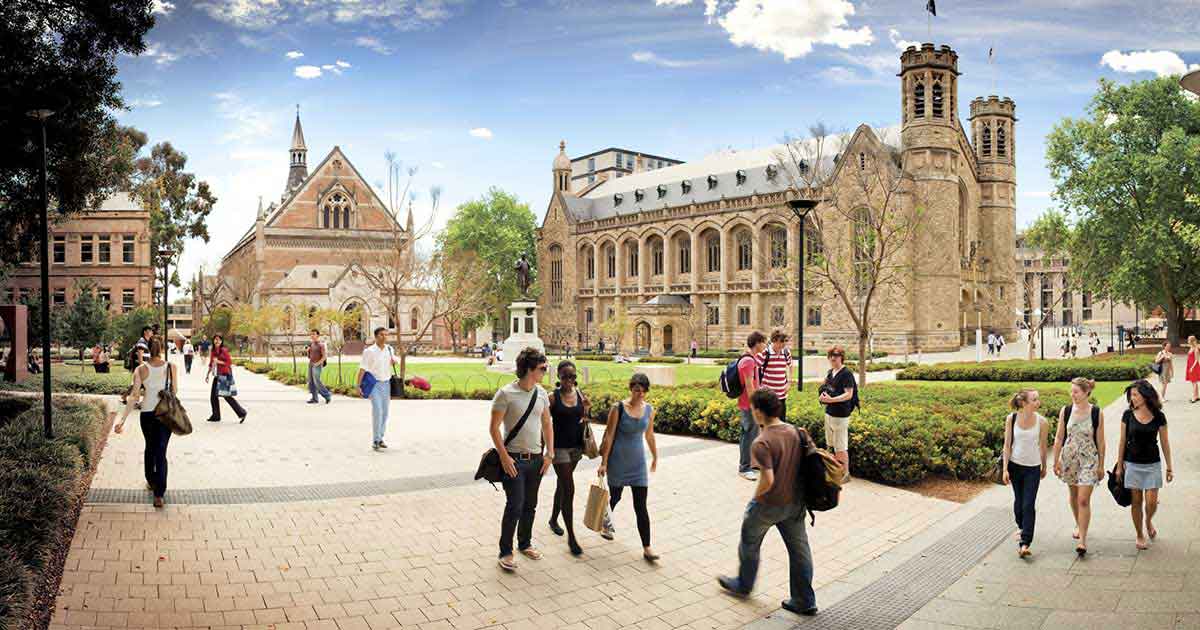
Things to Know Before Studying Abroad in Australia
Each education system in a country always has outstanding strengths that create its own brand. However, recently, Australia is gradually gaining the advantage to become a satisfactory choice for studying abroad. Unlike the geographical distance like the US and Canada, Australia not only has a closer location, reasonable study abroad costs, top quality education, but also has a pleasant temperate climate. Not only that, Australia is also famous for its large, dynamic cities with diverse cultures, suitable for the diverse needs of parents and international students.
If you want to find out information to study in Australia, let’s refer to the key points to understand before studying in Australia to make the right decision.
1. Overview of Australia
1.1 Geography and climate
Australia is a country located in the Southern Hemisphere, surrounded by two large oceans, the Pacific Ocean and the Indian Ocean. With an area of nearly 7.7 million km², Australia is the sixth largest country in the world. The country has a diverse terrain, including deserts, forests, mountains and seas.
With its diversity of landscapes and terrain, Australia also has many different climates. However, most of Australia has a tropical climate (nearly ⅓ of the territory), temperate climate (the rest). Divided into 4 distinct seasons as follows:
- Summer from December to February: The weather this season is hot and humid, with average temperatures ranging from 18 – 32 degrees Celsius. Very suitable for outdoor activities and vibrant, colorful beach tourism.
- Autumn from March to May: The average temperature is from 15 – 25 degrees Celsius. The air is quite cool, this is the wonderful red leaf season in Australia, along with many major festivals also held at this time.
- Winter from June to August: Average temperature ranges from 8 – 18 degrees Celsius. Some areas have extremely low temperatures, about -20 degrees Celsius. The landscape will be covered in white snow.
- Spring from September to November: A cool, relaxing time after the cold winter. The average temperature this season is around 18 – 32 degrees Celsius. This is the festival season of beautiful flowers in Australia.
1.2 States and territories
Australia has 6 states including New South Wales, Queensland, Victoria, South Australia, Western Australia and Tasmania. In addition, Australia also has two main territories on the majority of the continent that are also very famous: The Australian Capital Territory and The Northern Territory.
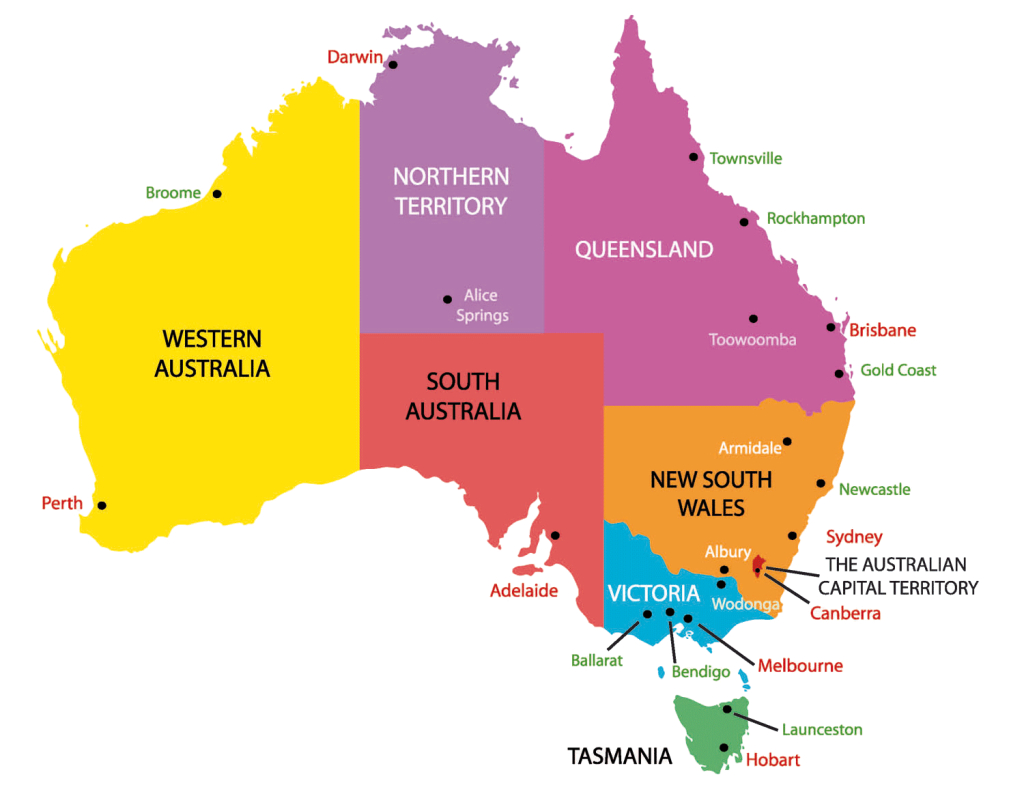
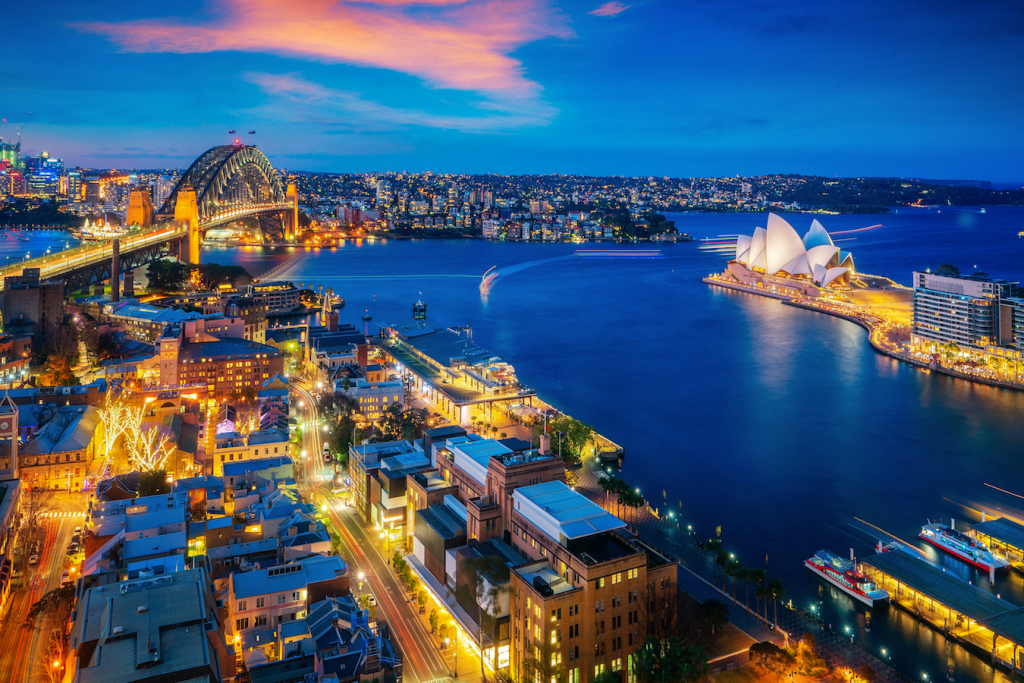
The capital of Australia is Canberra, located between two famous bustling cities, Sydney and Melbourne. In particular, Sydney is the capital of New South Wales state and also the most populous city and famous for famous symbols such as the Sydney Opera House and Sydney Harbor Bridge.
1.3 Culture and ethnic diversity
Australia is a multicultural and multi-ethnic country. The people here are quite friendly and open, ready to welcome people from all over.
According to the results of a census in Australia, about 23% of Australians live abroad and Australians with mixed cultural backgrounds account for up to 40%, which is a very large number. This creates an environment that is multicultural and diverse in language, food, clothing and customs.
1.4 Economics
Australia develops main economic sectors such as mining, agriculture, financial services, tourism and technology, etc. This country is one of the largest economies in the world and is also famous for exporting agricultural products and minerals.
In particular, Australia is the only country in the world that has not suffered an economic recession from 1992 to 2018. Thanks to its rapid and stable development, Australia is considered one of the countries worth living in. Therefore, by studying abroad and settling here, you can rest assured about the quality of life.
1.5 Language
Australia is a multicultural country, there is no official language but the majority of Australians use English. According to the 2016 Australian census, the number of people using English in this country accounts for 73%. This is a great advantage for international students, because you have the opportunity to improve your ability to communicate in English.
1.6 Some famous universities in Australia
Every year, the Australian education system will update the list of top schools based on strict criteria such as academic reputation, international student rate, research achievements, and the rate of students finding jobs after graduation. Below is a list of 5 schools with outstanding achievements in Australia:
| National ranking | School | World ranking |
| 1 | University of Melbourne (University of Melbourne) | 33 |
| 2 | Australian National University | 30 |
| 3 | University of Sydney (University of Sydney) | 41 |
| 4 | Monash University (Monash University) | 57 |
| 5 | The University of Queensland (The University of Queensland) | 50 |
2. Conditions for studying in Australia
2.1 Age to study abroad
Basically, the minimum age for visa issuance is 6 years old. If international students are under 18 years old, they must meet the following requirements:
- Be accompanied by a legal guardian including: father and mother
- Living with blood relatives
- Live in the same house as a guardian appointed by the school
- Have a certificate of accommodation, committing to safety and legality throughout the study period
2.2 English certificate
| Certificate | Score required |
| IELTS | 5.5 |
| TOEFL | 527 |
| Cambridge English/ Certificate in Advanced English) | 162 |
| Pearson (Pearson Test of English Academic) | 42 |
2.3 Education level
Depending on the school, level, and field of study, there will be different educational requirements. Most schools and industries require your academic performance to be good or better with a minimum IELTS certificate of 5.5. Some schools not only consider academic performance and subject average scores, but also consider scores of subjects related to the registered field of study.
2.4 Proof of finances for studying abroad
To ensure you are able to live independently in Australia, you need to provide evidence of sufficient financial capacity to pay tuition fees, daily living expenses and other living expenses. Often, you will need to provide documents such as bank account statements, sponsorship contracts, scholarships or other financial sources.
Proof of finances must be presented when applying for a visa. If you are under 18 years old, you must prove your guardian’s finances. Where sponsored by the Department of Defense or the Department of Foreign Affairs and Trade, evidence such as a letter of support must be provided.
2.5 Student visa
To enter Australia, you need to apply for a valid student visa. The visa application process includes online application, proof of finances, proof of English, and compliance with other requirements of immigration authorities.
Some real estate in Sydney with good prices can be referred to: https://myaustralianproperty.com/can-ho-sydney-dang-song/
As the leading reputable real estate company in Australia, My Australian Property offers many suitable housing and apartment options for both international students and investors. Furthermore, we also provide support services to answer all questions about real estate, study abroad and settlement needs.
MY AUSTRALIAN PROPERTY
- Australian headquarters: Suite 2021A, Tower 2 Darling Park, Level 20, 201 Sussex Street, Sydney, NSW 2000
- Zalo/Whatsapp: (+61) 475 39 6868
- Address: Floor 6-7, Me Linh Point Building, No. 2 Ngo Duc Ke, Ben Nghe Ward, District 1, Ho Chi Minh City
- Hotline/ Zalo: (+84) 797 299 997
- Email: info@myaustralianproperty.com
Related articles


Treasurer Jim Chalmers officially announced the 2026 Australian Federal Budget, focusing on reforming the tax system and enhancing national security in the context of inflation and global geopolitical turmoil. Housing Policy Reform The government focuses on addressing the housing and tax system to support the younger generation (Millennials and Gen Z) through systemic changes. From […]

The Federal Government has officially announced its 2026-2027 budget, with reforms to Australia’s real estate, tax system and increased housing supply aimed at helping more Australians own their homes. Support home ownership and increase supply Australian property tax reform: Change regulations on negative gearing and capital gains tax (CGT) incentives. The changes are estimated to […]

The birth of the Metro West line is not simply a transportation solution; it is symbolic of Sydney’s transformation into a connected megacity. With a record investment of up to 27.3 billion Australian dollars, the project promises to unlock the potential for tens of thousands of luxury apartments, turning areas along the route into the […]