

9 STEPS TO BUYING AUSTRALIAN PROPERTY FOR FOREIGNERS
Investing in Australian real estate has become popular with foreign investors and Australians. More surprisingly, many temporary or permanent visa holders miss out on these rare opportunities.

1. Reasons to invest in Australian real estate
Stability
Australia’s property market has a proven history of stable prices. What are the big differences between Australia and other real estate markets?
About 70% of Australian households are home owners so there is relatively little speculation. Housing supply is always low in most major cities. Australia has strict lending laws, managed through the Australian Regulatory Authority (APRA), which helps reduce the risk of market price bubbles.
In Australia, house prices have never fallen more than 20% in a year. Meanwhile, overseas real estate markets such as Hong Kong or the United States have suffered serious declines that have never happened in Australia.
House prices in volatile economies sometimes reach 70%, causing investors to suffer heavy losses. This happens due to speculation from foreign investors or market bubbles. Investors are less exposed in Australia because the majority of the housing market is occupied by citizens.
In fact, during the 2007 or 2009 global financial crisis, real estate prices in the UK and US dropped significantly. However, real estate prices in Australia are still increasing.
Continuously growing performance
Australian real estate has enjoyed steady growth over the past 100 years, with property prices doubling every seven to 10 years. One of the reasons behind this growth is the housing shortage occurring in many major cities.
The population is growing much faster than the rate of housing construction. The main reason for this is high levels of immigration and great demand for jobs.
Investing in Australia is easy
Many countries have very restrictive foreign investment laws or banking regulations that make investing difficult. The case in Australia is an exception:
- You do not need to set up a company in Australia or be an Australian citizen.
- Government approval for foreign nationals is straightforward, although additional taxes apply.
- Credit brokers can help foreigners qualify for home loans.
- In Australia, there are consumer protection laws through the National Consumer Credit Protection Act 2009 (NCCP Act).
- Australia’s legal system is based on the UK system, similar to Hong Kong or Singapore, so it is familiar to many foreign investors.
- There is little political, social or economic instability in Australia.
Country worth living in
Australia is famous for its culturally diverse cities and rich natural beauty:
- Queensland (QLD) is famous for its beaches and coral reefs.
- Victoria (VIC) has a stunning coastline stretching to South Australia (SA).
- The Northern Territory (NT) taps into a quiet countryside experience.
- New South Wales (NSW) with its peaceful Blue Mountains, beautiful coastline, strong economy and Sydney.
- Many prestigious Australian universities.
Over the next 50 years, it is expected that the migration trend to Australia will continue and property prices will increase.
Can investors buy both residential and commercial real estate?
Stability and growth are not just characteristics of houses, townhouses and apartments. Most commercial properties such as offices, factories and retail stores demonstrate groundbreaking profit margins. Many foreign investors tend to invest in hotels, pubs, commercial farms and residential and commercial developments.
Change foreign investment regulations
In December 2015, the Australian Government introduced new laws for foreign investors when purchasing real estate.
Under the new law, non-resident buyers can only invest in new housing, apartments under construction or vacant land for development purposes.
Foreigners who are not Australian citizens are not allowed to buy old houses, unless there is a plan to demolish the old house and build a new house within 4 years from the date of approval. Redevelopment must add to housing stock to be approved.
Non-residents buying property in Australia must seek permission from the Foreign Investment Review Board (FIRB), or could face stiff penalties including fines of up to $135,000, three years in prison or both.
2. Steps to buy Australian real estate
Find out your budget and prepare a plan
It is essential to research, plan and prepare a budget for purchasing real estate in Australia. You can search for a real estate agent and get advice from industry experts to choose a project that suits your needs.
Financial ability is extremely important in the buying and selling process. Australian banks will not approve loans if you cannot demonstrate clear financial ability, so prepare a realistic budget carefully.

Some properties near the center of Parramatta: SEE HERE
Step 1 – Organize a team of experts
Lawyer
Search for a private lawyer to secure legal work. They play an important role in buying and selling transactions. Note that the appointed attorney must be located in the same state as the property you intend to purchase or at least licensed to operate in that state.
Mortgage broker
A mortgage broker is experienced in applying for mortgages for non-Australian residents. Experienced mortgage brokers often work with many banks and financial institutions, so they can advise you on suitable loan policies.
Accounting
If necessary, choosing an accountant will help you structure your finances and save money on tax as they are experts in Australian tax law. In other cases, if you want to establish a company and trust to control your investments, an accountant is a necessary choice.
The accountant can be located anywhere in Australia, in another city or state, no problem.
In particular, it is necessary to pay attention to taxes on real estate in Australia such as registration tax, land tax, vacant house tax,…
Real estate agent
Real estate agents play a very important role if you are abroad and cannot physically inspect the property. A real estate agent is a unit that provides real estate products that suit the needs and negotiates on behalf of the buyer.
The real estate agent must be licensed and located in the state in which you want to purchase real estate. A reputable real estate agent can provide objective, independent advice to help customers make the right decisions.
Step 2 – Determine finances or borrowing capacity
Determine financing or get approved for a loan before starting your real estate search. This helps buyers capture good opportunities in the market. More importantly, determine your ability and finances to borrow, avoid wasting time searching for real estate and limit other financial risks.
Step 3 – Prepare loan documents (for buyers who need a loan)
Applying for a mortgage as a non-resident can be a bit difficult as the lending criteria are quite complex. It is necessary to carefully prepare loan documents, such as payroll, tax reports and employment letters to prove income, which is extremely important, especially for foreign investors.
Step 4 – Search for the right property
This is the right time to start looking for the right property. Or ask for the support of a reputable real estate agent.
If you don’t go through a real estate agent, you can compare and price real estate in the same segment being sold in the area yourself to get the most accurate figure.
Step 5 – Apply for FIRB investment license
If you are not an Australian citizen or temporary visa holder, you are legally required to apply for permission from the Foreign Investment Review Board (FIRB) to buy property in Australia.
In the case of Australian citizens, Australian permanent residents and New Zealand (NZ) citizens, you can skip this step.
Applying for a FIRB license is a simple process and usually takes up to 2 weeks from the date of application.
The investment license application fee may vary depending on the value of the real estate:
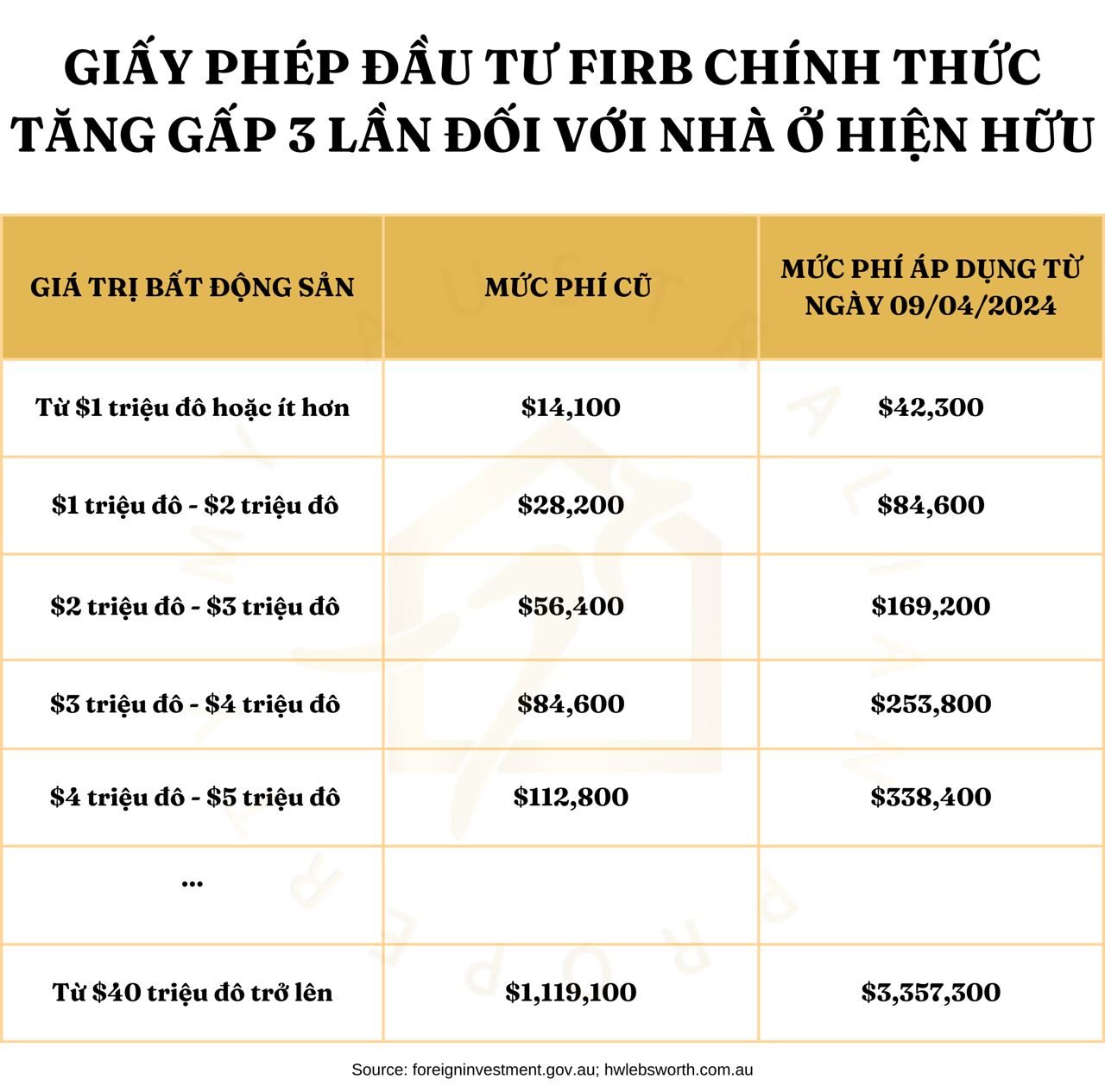
Note: Some real estate developers have received prior FIRB approval for the entire project development process. There is nothing to worry about if you buy these newly built apartments.
Step 6 – Negotiate the contract
Each Australian state has its own real estate laws, which is why you need the guidance of a lawyer. A lawyer will tell you important information before buying and when it is safe to sign a real estate purchase contract (sales contract).
The buyer can ask a lawyer to review the contract and add any terms if necessary. FIRB approved sales allow the buyer to cancel the contract in the event of failure to receive Australian government approval.
Step 7 – Exchange contracts and pay deposit
Exchange contracts once the loan is officially approved and authorized by a lawyer.
The amount of the deposit is negotiable and varies from state to state. Normally it will be around 10%.
Note that after signing the deposit commitment, the buyer cannot cancel the contract, so make sure of legal issues before signing and before paying the deposit.
Step 8 – Wait for approval from FIRB
In the official contract, there is a very important clause “Subject to FIRB – must be approved by FIRB”, allowing FIRB 30 days to make a decision.
At this time, work with an attorney on the terms that in the event of FIRB rejection, you will not lose your deposit.
FIRB registration is simple to do and will usually be the responsibility of a lawyer.
Step 9 – Settlement (final settlement)
“Settlement” is the term used when real estate changes hands and a loan is approved. This process is carried out by an attorney with a bank and a mortgage broker.
Real estate ownership is guaranteed by the bank. If the property is being rented then the property manager can start advertising.
To discuss any matters relating to property sales and Australian market information, contact us today.
Source: Home Loan Experts
Disclaimer:
Article content is based on reliable information sources. However, the information herein is for general reference only and should not be considered official or complete. Use of the content and information on this website is the sole responsibility of the reader. We are not responsible for any consequences, damages or losses caused to readers or any third parties related to the use of information on this article or website, whether directly or indirectly.
Related articles


Treasurer Jim Chalmers officially announced the 2026 Australian Federal Budget, focusing on reforming the tax system and enhancing national security in the context of inflation and global geopolitical turmoil. Housing Policy Reform The government focuses on addressing the housing and tax system to support the younger generation (Millennials and Gen Z) through systemic changes. From […]

The Federal Government has officially announced its 2026-2027 budget, with reforms to Australia’s real estate, tax system and increased housing supply aimed at helping more Australians own their homes. Support home ownership and increase supply Australian property tax reform: Change regulations on negative gearing and capital gains tax (CGT) incentives. The changes are estimated to […]

The birth of the Metro West line is not simply a transportation solution; it is symbolic of Sydney’s transformation into a connected megacity. With a record investment of up to 27.3 billion Australian dollars, the project promises to unlock the potential for tens of thousands of luxury apartments, turning areas along the route into the […]